Description of biotope or habitat type
To understand more about what this page is describing, see How to use the classification. See also How to cite.
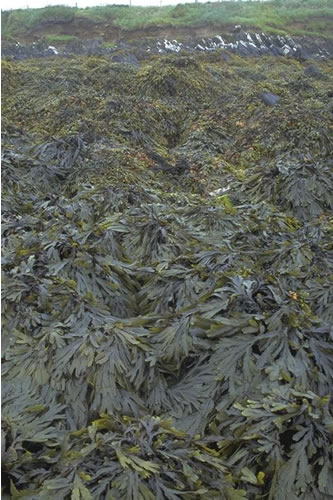
Fucus serratus on full salinity sheltered lower eulittoral rock
Physical habitat description
| Salinity | Full (30-35 ppt) |
|---|---|
| Wave exposure | Moderately exposed, Sheltered, Very sheltered, Extremely sheltered |
| Tidal streams | |
| Substratum | Bedrock |
| Zone | Eulittoral - lower |
| Depth Band | Lower shore |
| Other Features |
Download comparative physical and biological data. The comparative tables enable a rapid comparison of the species composition and principal physical characteristics between a given set of biotopes.

- Records used to define the biotope (core records)
- Other records assigned to this biotope, marked as 'certain'
- Other records assigned to this biotope, marked as 'uncertain'
Point data based on records in the UK Marine Recorder Snapshot.
Description
Sheltered lower eulittoral rock subject to fully marine conditions characterised by a dense canopy of the wrack Fucus serratus. There is a wide range of associated species found on the surface of the rock underneath the canopy, including the barnacle Semibalanus balanoides, limpets Patella vulgata, winkles Littorina littorea, and even mussels Mytilus edulis can be present in cracks and crevices. These species are usually found in higher abundance further up on the shore. There may also be a number of other seaweeds present, including the red Corallina officinalis and Mastocarpus stellatus, the wrack Fucus vesiculosus and the green Ulva intestinalis, Ulva lactuca or Cladophora rupestris, though these usually are present in low numbers if present at all. The sponge Halichondria panicea can be present underneath the F. serratus canopy in moist cracks or minor overhangs. Polychaetes such as Spirobranchus triqueter and Spirorbis spp. are present in their white calcareous tubes on the rock.
Situation
This biotope usually occurs immediately below a Fucus vesiculosus-barnacle mosaic (FvesB) on moderately exposed shores or a dense canopy of F. vesiculosus (Fves) or Ascophyllum nodosum (Asc.FS) on sheltered shores; consequently low densities of these species (typically less than Frequent) may also occur in this biotope. The sub littoral fringe below on moderately exposed shores is dominated by the kelp Laminaria digitata (Ldig; Ldig.LdigBo), while the kelp Saccharina latissima may co-dominate on sheltered shores (Lsac.Ldig; Lsac.Ft).
Temporal variation
Fluctuations from year to year in the abundance of the F. serratus and the red seaweeds due to e.g. severe storms may convert this biotope into either Fser.R or into a red seaweed dominated biotope on moderately exposed shores.
Characterising species
| Taxon | Relative importance of taxon for defining this community (%) | Typical abundance - SACFOR scale | % of core records where taxon was recorded |
|---|---|---|---|
| Fucus serratus | 44 | Abundant | 81-100% |
| Semibalanus balanoides | 8 | Frequent | 41-60% |
| Patella vulgata | 8 | Occasional | 41-60% |
| Cladophora rupestris | 5 | Frequent | 41-60% |
| Ulva intestinalis | 4 | Frequent | 21-40% |
| Littorina littorea | 4 | Occasional | 41-60% |
| Mastocarpus stellatus | 4 | Frequent | 41-60% |
| Spirobranchus triqueter | 2 | Occasional | 21-40% |
| Spirorbinae | 2 | Common | 21-40% |
| Spirorbis | 2 | Occasional | 21-40% |
| Ulva lactuca | 2 | Occasional | 21-40% |
| Corallina officinalis | 1 | Occasional | 21-40% |
| Halichondria panicea | 1 | Frequent | 21-40% |
| Mytilus edulis | 1 | Occasional | 21-40% |
| Fucus vesiculosus | 1 | Occasional | 21-40% |
Similar biotopes or habitat types
LR.MLR.BF.Fser.Bo
Occurs on large boulders and in a wider exposure range. Has a high species richness and mobile species such as the crabs Porcellana platycheles and Cancer pagurus and the starfish Asterias rubens are present in low numbers.
LR.MLR.BF.Fser.R
Occurs in slightly more wave exposed conditions. The species diversity and abundance of red seaweeds are higher. D. pumila can form dense populations on the F. serratus fronds.
LR.HLR.FT.FserT
Occurs on bedrock and boulders in very sheltered conditions. It has a very high species diversity and sponges such as H. panicea and Hymeniacidon perlevis and bryozoans such as Electra pilosa or Alcyonidium gelatinosum are characteristic for this tide-swept biotope.
LR.LLR.FVS.FserVS
Occurs on variable salinity lower eulittoral rock. Similar species composition, but the individual M. edulis are large and the barnacle Austrominius modestus can be present in high numbers.Classification history of this biotope or habitat type
| Classification version | Code |
|---|---|
| 1995 | LRK.FSE.FSE |