Description of biotope or habitat type
To understand more about what this page is describing, see How to use the classification. See also How to cite.
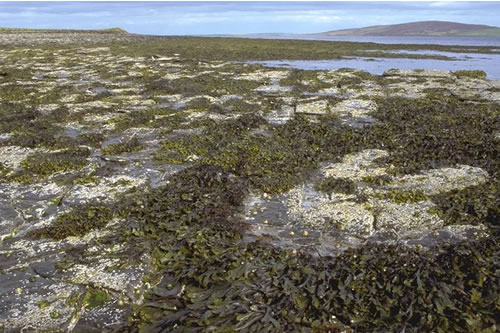
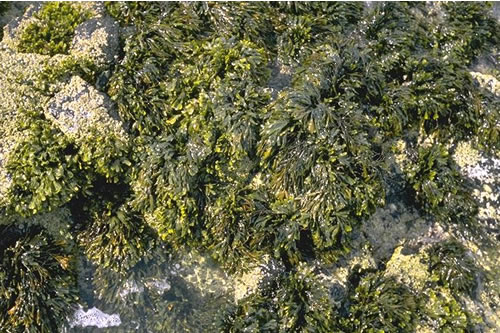
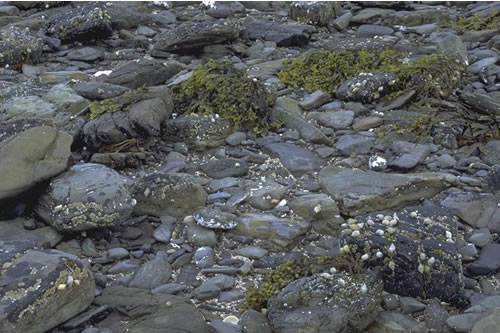
Fucus vesiculosus and barnacle mosaics on moderately exposed mid eulittoral rock
Physical habitat description
| Salinity | Full (30-35 ppt) |
|---|---|
| Wave exposure | Exposed, Moderately exposed |
| Tidal streams | |
| Substratum | Bedrock; boulders |
| Zone | Eulittoral - mid |
| Depth Band | |
| Other Features |
Download comparative physical and biological data. The comparative tables enable a rapid comparison of the species composition and principal physical characteristics between a given set of biotopes.

- Records used to define the biotope (core records)
- Other records assigned to this biotope, marked as 'certain'
- Other records assigned to this biotope, marked as 'uncertain'
Point data based on records in the UK Marine Recorder Snapshot.
Description
Exposed to moderately exposed mid eulittoral bedrock and boulders are frequently characterised by a mosaic of the barnacle Semibalanus balanoides and the wrack Fucus vesiculosus. The limpet Patella vulgata and the whelk Nucella lapillus are typically present, whilst the anemone Actinia equina and small individuals of the mussel Mytilus edulis are confined to crevices. Underneath the F. vesiculosus is a community of red seaweeds, including Corallina officinalis, Mastocarpus stellatus and Osmundea pinnatifida, usually with the winkles Littorina littorea and Littorina spp. present. Opportunistic seaweeds such as Ulva intestinalis may occur in patches recently cleared on the rock or growing on the M. edulis.
Situation
On exposed shores FvesB is found below the black lichen Verrucaria maura and sparse barnacles biotope (Ver.B) and/or below the Chthamalus spp. and P. vulgata biotopes (Cht.Cht). FvesB is found above the biotope dominated by the wrack Himanthalia elongata (Him) or the red seaweed biotopes (Coff; R). FvesB forms an intermediate along the wave exposure gradient between the exposed shore barnacle-P. vulgata biotopes (Sem.FvesR) and the sheltered shore F. vesiculosus biotope (Fves). Vertical surfaces tend to be dominated by the barnacle-P. vulgata biotope (Sem).
Temporal variation
On some shores, particularly those, which are moderately exposed to wave action, temporal fluctuations in the abundance of limpets, barnacles and fucoid seaweeds may occur. As a result, over a number of years, a single shore may cycle between the barnacle-P. vulgata dominated biotope (Sem.FvesR), through this mosaic (FvesB) to a F. vesiculosus-dominated biotope (Fves).
Characterising species
| Taxon | Relative importance of taxon for defining this community (%) | Typical abundance - SACFOR scale | % of core records where taxon was recorded |
|---|---|---|---|
| Semibalanus balanoides | 21 | Abundant | 81-100% |
| Fucus vesiculosus | 18 | Common | 81-100% |
| Patella vulgata | 16 | Common | 81-100% |
| Littorina | 7 | Common | 21-40% |
| Mytilus edulis | 5 | Occasional | 61-80% |
| Ulva intestinalis | 4 | Occasional | 61-80% |
| Osmundea pinnatifida | 3 | Occasional | 41-60% |
| Nucella lapillus | 3 | Frequent | 61-80% |
| Corallinaceae | 2 | Occasional | 61-80% |
| Actinia equina | 2 | Occasional | 41-60% |
| Corallina officinalis | 2 | Occasional | 41-60% |
| Littorina littorea | 2 | Frequent | 41-60% |
| Mastocarpus stellatus | 2 | Occasional | 41-60% |
Similar biotopes or habitat types
LR.HLR.MusB.Sem.FvesR
Occurs at a similar wave exposure, but also on steeper slopes and vertical faces. The community is similar to LR.MLR.BF.FvesB, but F. vesiculosus is present at lower abundance (Occasional) and wracks such as Fucus serratus and Ascophyllum nodosum are usually not present. F. vesiculosus can be non-vesiculate (i.e. bladderless).
LR.LLR.F.Fves
Occurs on more sheltered shores on bedrock and large boulders. F. vesiculosus dominates (Abundant) and there is a lower red seaweed diversity. S. balanoides, P. vulgata and N. lapillus occur less frequently and at lower abundance when present.Classification history of this biotope or habitat type
| Classification version | Code |
|---|---|
| 1997 (97.06) | MLR.FvesB |
| 1995 | LRK.FVES.BP |
Photos