Description of biotope or habitat type
To understand more about what this page is describing, see How to use the classification. See also How to cite.
Cerastoderma edule and polychaetes in littoral muddy sand
Physical habitat description
| Salinity | Full (30-35 ppt), Reduced (18-30ppt), Variable (18-35 ppt) |
|---|---|
| Wave exposure | Moderately exposed, Sheltered, Very sheltered, Extremely sheltered |
| Tidal streams | |
| Substratum | Fine sand or muddy sand |
| Zone | |
| Depth Band | Lower shore, Mid shore, Upper shore |
| Other Features |
Download comparative physical and biological data. The comparative tables enable a rapid comparison of the species composition and principal physical characteristics between a given set of biotopes.

- Records used to define the biotope (core records)
- Other records assigned to this biotope, marked as 'certain'
- Other records assigned to this biotope, marked as 'uncertain'
Point data based on records in the UK Marine Recorder Snapshot.
Description
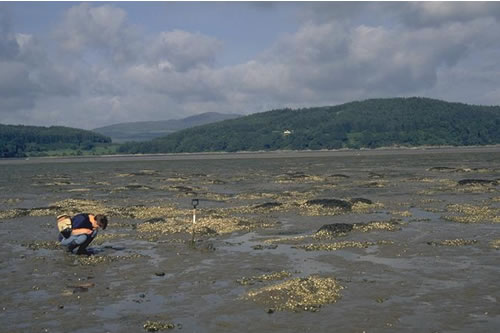
Extensive clean fine sand or muddy sand shores with abundant cockles Cerastoderma edule. The community consists of the polychaetes Eteone longa, Scoloplos armiger, Pygospio elegans, Spio filicornis and Capitella capitata, the crustaceans Bathyporeia sarsi, Bodotria arenosa arenosa and Crangon crangon, the spire shell Peringia ulvae, as well as the cockle C. edule and the baltic tellin Macoma balthica. This biotope carries commercially viable stocks of C. edule, and it is therefore possible to find areas of this habitat where the infauna may have been changed through recent cockle dredging. Cockle dredging can result in a reduced bivalve abundance and reduced densities of some polychaete species, including P. elegans (Moore, 1991). At the outer edges of large flats, there may be a zone between the cockle beds and more exposed sands, where there are fewer cockles and B. sarsi is the commoner species.
Situation
The community is found mainly on the mid and lower shore where the sediment is water-saturated most of the time. Where it occurs in muddy sand, CerPo has broad transition areas with MacAre and the MEST communities, and where it occurs on clean sand shores, it may have broad transition areas with Myt.Sa. Higher on the shore, adjacent to this biotope, BatCare is found, with fewer polychaete and bivalve species due to the drier sediment found on the upper shore.
Temporal variation
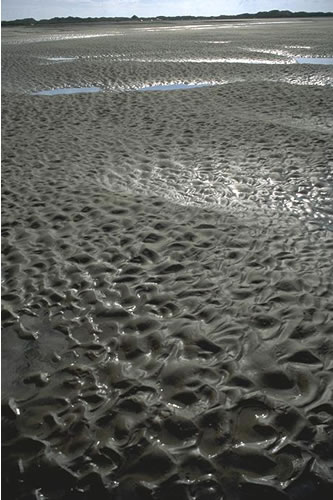
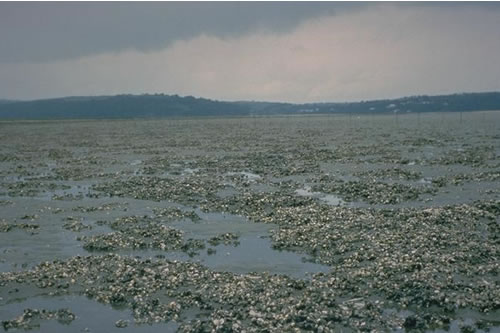
A layer of mud with dense spionid polychaetes may build up on cockle beds in sheltered areas, creating a cohesive muddy layer 10-15 cm thick overlying the whole area. This may break up leaving a series of pits and patches with miniature cliffs, giving it an appearance similar to a stony shore when seen from a distance. It should be noted that where it occurs, Hydrobia ulvae tends to move a lot and may be highly variable in abundance.
Characterising species
| Taxon | Relative importance of taxon for defining this community (%) | Typical abundance - SACFOR scale | Typical abundance - (count per m2) | % of core records where taxon was recorded |
|---|---|---|---|---|
| Odostomia suboblonga | 41 | Abundant | 5357 | 61-80% |
| Cerastoderma edule | 17 | Abundant | 715 | 81-100% |
| Macoma balthica | 11 | Common | 574 | 81-100% |
| Capitella capitata | 8 | Common | 160 | 41-60% |
| Pygospio elegans | 8 | Common | 832 | 61-80% |
| Scoloplos armiger | 4 | Abundant | 70 | 41-60% |
| Bodotria arenosa arenosa | 2 | Common | 69 | 21-40% |
| Eteone longa | 2 | Common | 67 | 61-80% |
| Peringia ulvae | 1 | Common | 25 | 41-60% |
| Bathyporeia sarsi | 1 | Frequent | 46 | 41-60% |
| Crangon crangon | 1 | Common | 57 | 21-40% |
Similar biotopes or habitat types
LS.LSa.FiSa.Po
These biotopes occur under slightly more exposed, fully marine conditions, in sediments that have a lower silt/clay fraction. The principal infaunal difference is the absence of C. edule and M. balthica.
LS.LSa.MuSa.MacAre
Occurs on more sheltered shores with muddier sediments. The lugworm Arenicola marina is common, and C. edule is not always present.
LS.LSa.MuSa.HedMacEte
Tends to occur more in fully marine conditions, higher up on the shore. The principal differences in the infauna are that Hediste diversicolor is common and E. longa is abundant, whereas C. edule occurs only in about half of the samples.
LS.LBR.LMus.Myt.Sa
Occurs in similar physical conditions, with a similar infaunal community. The difference is that the mussel M. edulis is abundant, forming extensive clumps and beds on the surface of the sediment.Classification history of this biotope or habitat type
| Classification version | Code |
|---|---|
| 1997 (97.06) | LMS.MS.MacAre (part) |
| 1997 (97.06) | LMS.MS.PCer |
| 1996 (6.95) | LMS.AreBv (part) |
| 1995 | LMSND.PC |
Photos