Description of biotope or habitat type
To understand more about what this page is describing, see How to use the classification. See also How to cite.
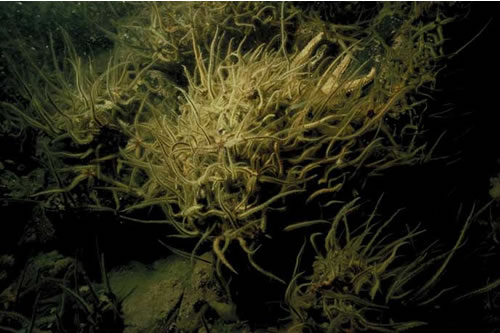
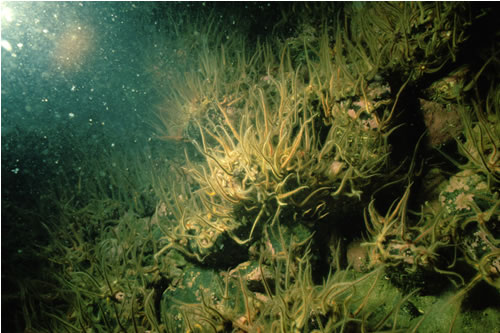
Dense brittlestars with sparse Ascidia mentula and Ciona intestinalis on sheltered circalittoral mixed substrata
Physical habitat description
| Salinity | Full (30-35 ppt) |
|---|---|
| Wave exposure | Moderately exposed, Sheltered, Very sheltered |
| Tidal streams | Moderately strong (1-3 kn), Weak (>1 kn), Very weak (negligible) |
| Substratum | Bedrock, boulders, cobbles, gravel, sand, mud |
| Zone | Circalittoral |
| Depth Band | 5-10 m, 10-20 m, 20-30 m, 30-50 m |
| Other Features |
Download comparative physical and biological data. The comparative tables enable a rapid comparison of the species composition and principal physical characteristics between a given set of biotopes.

- Records used to define the biotope (core records)
- Other records assigned to this biotope, marked as 'certain'
- Other records assigned to this biotope, marked as 'uncertain'
- Predicted extent of the level 3 (for sublittoral rock & deep sea) or 4 (for sublittoral sediment) habitat
Point data based on records in the UK Marine Recorder Snapshot. Predicted habitat extent is from UKSeaMap.
Description
This biotope is typically found on wave-sheltered sites (although it may be found in wave-exposed through to extremely wave-sheltered conditions), on circalittoral mixed substrata (Bedrock, boulders, cobbles, pebbles and gravel), subject to moderately strong to weak tidal streams. This biotope often has a silty appearance in parallel with AmenCio.Ant but is characterised by a dense carpet of brittlestars (Ophiothrix fragilis, Ophiocomina nigra and to a lesser extent Ophiura albida) which virtually cover the seabed. Where the underlying substratum is visible, pink coralline crusts and the white calcareous tubes of the keelworm Spirobranchus triqueter are often observed. Hydroids and bryozoans are scarce, perhaps partly due to the smothering effect of the brittlestars and possibly due to the grazing pressure of the sea urchin Echinus esculentus which is occasionally recorded. Other echinoderms present include Asterias rubens and Crossaster papposus. The solitary ascidian Ciona intestinalis may be seen attached to isolated rocks and boulders, whilst on the tops and sides of larger boulders, dead man's fingers Alcyonium digitatum may be recorded. The hermit crab Pagurus bernhardus is often recorded, whilst under boulders and in crevices the claws belonging to the long-clawed squat lobster Munida rugosa may be seen.
Situation
AmenCio.Bri is found in predominantly sheltered areas, so in the infralittoral zone above, kelp forest formed by dense Saccharina latissima and cape-form Laminaria hyperborea are frequently recorded. A dense understorey of red algae is also present.
Temporal variation
Not known.
Characterising species
| Taxon | Relative importance of taxon for defining this community (%) | Typical abundance - SACFOR scale | % of core records where taxon was recorded |
|---|---|---|---|
| Ophiothrix fragilis | 27 | Abundant | 81-100% |
| Ophiocomina nigra | 21 | Common | 81-100% |
| Corallinaceae | 7 | Frequent | 41-60% |
| Echinus esculentus | 6 | Occasional | 61-80% |
| Asterias rubens | 4 | Occasional | 61-80% |
| Ophiura albida | 4 | Frequent | 41-60% |
| Pagurus bernhardus | 4 | Occasional | 41-60% |
| Spirobranchus triqueter | 3 | Frequent | 41-60% |
| Crossaster papposus | 2 | Occasional | 41-60% |
| Alcyonium digitatum | 1 | Occasional | 41-60% |
| Ciona intestinalis | 1 | Occasional | 21-40% |
| Munida rugosa | 1 | Occasional | 21-40% |
Similar biotopes or habitat types
CR.MCR.EcCr.FaAlCr.Bri
This biotope occurs on more wave-exposed mixed substratum, subject to varying amounts of tide. Tends to have similar species diversity as CR.LCR.BrAs.AmenCio.Bri, but delicate hydroids have been replaced by more robust species such as Abietinaria abietina. Occasionally, bryozoan crusts may be present in CR.MCR.EcCr.FaAlCr.Bri.Photos