Description of biotope or habitat type
To understand more about what this page is describing, see How to use the classification. See also How to cite.
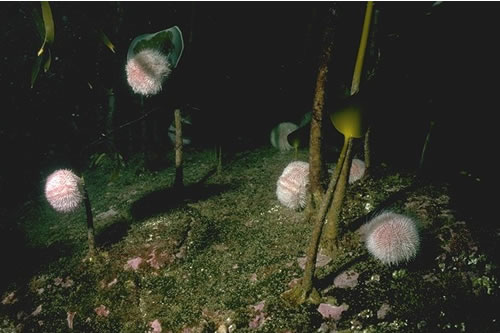
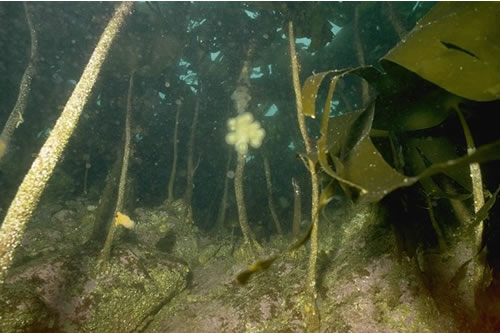
Grazed Laminaria hyperborea park with coralline crusts on lower infralittoral rock
Physical habitat description
| Salinity | Full (30-35 ppt) |
|---|---|
| Wave exposure | Exposed, Moderately exposed |
| Tidal streams | Weak (>1 kn), Very weak (negligible) |
| Substratum | Bedrock; boulders |
| Zone | Infralittoral - lower |
| Depth Band | 10-20 m |
| Other Features | Urchin grazing |
Download comparative physical and biological data. The comparative tables enable a rapid comparison of the species composition and principal physical characteristics between a given set of biotopes.

- Records used to define the biotope (core records)
- Other records assigned to this biotope, marked as 'certain'
- Other records assigned to this biotope, marked as 'uncertain'
- Predicted extent of the level 3 (for sublittoral rock & deep sea) or 4 (for sublittoral sediment) habitat
Point data based on records in the UK Marine Recorder Snapshot. Predicted habitat extent is from UKSeaMap.
Description
Exposed to moderately exposed Laminaria hyperborea kelp park in some areas is intensively grazed by the urchin Echinus esculentus. The rock surface lacks a significant turf of foliose seaweeds and generally looks bare, though coralline algal crusts and some grazing-resistant animals such as the tube-building polychaete Spirobranchus triqueter cover it. The kelp stipes may or may not be grazed; in the most extremely grazed areas, the stipes are also devoid of seaweeds. More usually, however, the stipes offers a refuge from grazing, and are characterised by dense turfs of red seaweeds, especially Phycodrys rubens and Delesseria sanguinea. Brown seaweeds present include Cutleria multifida, Saccharina latissima and Dictyota dichotoma. The fauna within a grazed kelp park is also relatively sparse, though some species will survive in cracks and crevices or under boulders including the ascidian Clavelina lepadiformis. The encrusting bryozoan Parasmittina trispinosa and the anthozoans Alcyonium digitatum, Urticina felina and Caryophyllia smithii often characterise vertical or overhanging rock. Mobile species include the gastropods Steromphala cineraria and Calliostoma zizyphinum and the hermit crab Pagurus bernhardus The echinoderms Ophiocomina nigra, Ophiothrix fragilis and Crossaster papposus, generally absent from the kelp forest, can be found in these kelp parks along with Asterias rubens and Antedon bifida.
Situation
This biotope generally occurs below a grazed kelp forest (Lhyp.GzFt) but can also occur below ungrazed kelp forests on exposed sites where wave action can dislodge urchins from shallow rock. The grazed circalittoral biotope FaAlCr often occurs on the bedrock or boulders below.
Temporal variation
Fluctuations in the numbers of E. esculentus may give foliose seaweeds a chance to re-grow periodically. Further information is required on the temporal variation within these grazed kelp parks and the changes in community structure when grazing pressure decreases.
Characterising species
| Taxon | Relative importance of taxon for defining this community (%) | Typical abundance - SACFOR scale | % of core records where taxon was recorded |
|---|---|---|---|
| Echinus esculentus | 14 | Common | 81-100% |
| Corallinaceae | 12 | Abundant | 81-100% |
| Laminaria hyperborea | 9 | Frequent | 81-100% |
| Asterias rubens | 5 | Occasional | 61-80% |
| Spirobranchus triqueter | 5 | Frequent | 61-80% |
| Cutleria multifida | 4 | Frequent | 21-40% |
| Steromphala cineraria | 4 | Occasional | 61-80% |
| Alcyonium digitatum | 3 | Occasional | 61-80% |
| Antedon bifida | 3 | Occasional | 41-60% |
| Calliostoma zizyphinum | 3 | Occasional | 41-60% |
| Phycodrys rubens | 3 | Occasional | 41-60% |
| Clavelina lepadiformis | 2 | Occasional | 41-60% |
| Dictyota dichotoma | 2 | Occasional | 41-60% |
| Ophiocomina nigra | 2 | Occasional | 21-40% |
| Ophiothrix fragilis | 2 | Occasional | 41-60% |
| Urticina felina | 2 | Occasional | 41-60% |
| Caryophyllia smithii | 1 | Occasional | 41-60% |
| Crossaster papposus | 1 | Rare | 41-60% |
| Delesseria sanguinea | 1 | Occasional | 41-60% |
| Saccharina latissima | 1 | Occasional | 21-40% |
| Pagurus bernhardus | 1 | Occasional | 21-40% |
| Parasmittina trispinosa | 1 | Occasional | 41-60% |
Similar biotopes or habitat types
IR.MIR.KR.Lhyp.GzFt
Found above the kelp park and has a higher abundance of kelps but similar species composition to the park (IR.MIR.KR.Lhyp.GzPk).
IR.HIR.KSed.XKScrR
Bare rock surfaces beneath the kelp canopy may also be caused by sand-scour and should not be confused with the barren appearance of a community decimated (reduced) by grazing.Photos