Description of biotope or habitat type
To understand more about what this page is describing, see How to use the classification. See also How to cite.
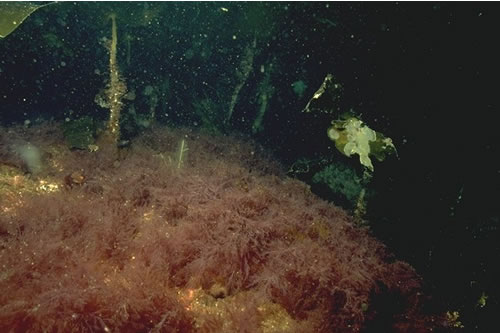
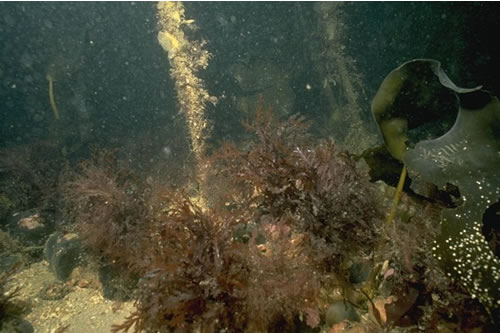
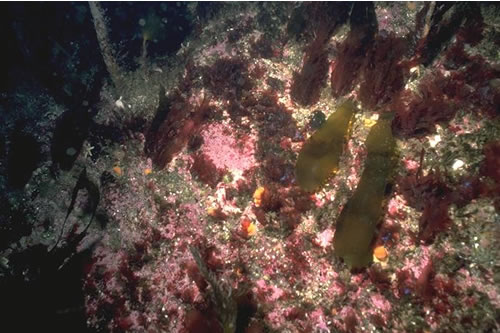
Laminaria hyperborea park with dense foliose red seaweeds on exposed lower infralittoral rock
Physical habitat description
| Salinity | Full (30-35 ppt) |
|---|---|
| Wave exposure | Very exposed, Exposed |
| Tidal streams | Moderately strong (1-3 kn), Weak (>1 kn) |
| Substratum | Bedrock; large boulders |
| Zone | Infralittoral - lower |
| Depth Band | 10-20 m, 20-30 m, 30-50 m |
| Other Features |
Download comparative physical and biological data. The comparative tables enable a rapid comparison of the species composition and principal physical characteristics between a given set of biotopes.

- Records used to define the biotope (core records)
- Other records assigned to this biotope, marked as 'certain'
- Other records assigned to this biotope, marked as 'uncertain'
- Predicted extent of the level 3 (for sublittoral rock & deep sea) or 4 (for sublittoral sediment) habitat
Point data based on records in the UK Marine Recorder Snapshot. Predicted habitat extent is from UKSeaMap.
Description
Very exposed to exposed lower infralittoral bedrock or large boulders characterised by a kelp park of Laminaria hyperborea with a dense turf of foliose red seaweeds and encrusting coralline algae. These red seaweeds dominate kelp stipes and bedrock in a similar abundance and composition to the upper infralittoral kelp forest, the most commonly occurring species being Metacallophyllis laciniata, Cryptopleura ramosa, Plocamium cartilagineum, Kallymenia reniformis, Delesseria sanguinea, Phycodrys rubens, Hypoglossum hypoglossoides, Heterosiphonia plumosa and Bonnemaisonia asparagoides. In addition, moderate to high abundance of foliose brown seaweeds, such as Dictyota dichotoma are more common than in the kelp forest above. More upper circalittoral fauna occur in the park than in the kelp forest, such as the cup-coral Caryophyllia smithii. Some species more often present in the kelp park than the forest include the anthozoan Alcyonium digitatum and the featherstar Antedon bifida. The urchin Echinus esculentus, the gastropods Steromphala cineraria and Calliostoma zizyphinum and the starfish Asterias rubens are normally present underneath the canopy along with the anthozoans Urticina felina and Corynactis viridis. The sponge Cliona celata is also present often found boring into shells or soft rock where available. The bryozoan Membranipora membranacea can be found on the L. hyperborea fronds along with the hydroid Obelia geniculata and the ascidian Botryllus schlosseri. The polychaete Spirobranchus sp. is present on the rock surface.
Situation
This biotope usually occurs below the exposed kelp forests (LhypFa and LhypR.Ft). At some sites, a dense band of D. dichotoma may form a separate zone below (FoR). Where seasonally unstable cobbles and/or boulders are present adjacent to and/or below the bedrock supporting the L. hyperborea LsacSac may occur.
Temporal variation
In the late summer both the kelp and the foliose seaweeds can become heavily encrusted with the bryozoan crusts Electra pilosa and Membranipora membranacea. Temporal variation within the community structure is unknown.
Characterising species
| Taxon | Relative importance of taxon for defining this community (%) | Typical abundance - SACFOR scale | % of core records where taxon was recorded |
|---|---|---|---|
| Laminaria hyperborea | 8 | Frequent | 81-100% |
| Delesseria sanguinea | 6 | Frequent | 81-100% |
| Corallinaceae | 5 | Frequent | 61-80% |
| Dictyota dichotoma | 5 | Frequent | 61-80% |
| Alcyonium digitatum | 4 | Occasional | 61-80% |
| Asterias rubens | 4 | Occasional | 61-80% |
| Corynactis viridis | 4 | Frequent | 41-60% |
| Cryptopleura ramosa | 4 | Frequent | 61-80% |
| Echinus esculentus | 4 | Frequent | 61-80% |
| Calliostoma zizyphinum | 3 | Occasional | 61-80% |
| Metacallophyllis laciniata | 3 | Frequent | 61-80% |
| Caryophyllia smithii | 3 | Occasional | 61-80% |
| Plocamium cartilagineum | 3 | Occasional | 61-80% |
| Antedon bifida | 2 | Frequent | 41-60% |
| Cliona celata | 2 | Occasional | 41-60% |
| Steromphala cineraria | 2 | Occasional | 41-60% |
| Kallymenia reniformis | 2 | Occasional | 61-80% |
| Obelia geniculata | 2 | Frequent | 41-60% |
| Spirobranchus triqueter | 2 | Occasional | 41-60% |
| Urticina felina | 2 | Occasional | 41-60% |
| Membranipora membranacea | 1 | Occasional | 41-60% |
| Acrosorium ciliolatum | 1 | Frequent | 41-60% |
| Bonnemaisonia asparagoides | 1 | Occasional | 41-60% |
| Botryllus schlosseri | 1 | Occasional | 41-60% |
| Heterosiphonia plumosa | 1 | Frequent | 41-60% |
| Hypoglossum hypoglossoides | 1 | Occasional | 41-60% |
| Phycodrys rubens | 1 | Frequent | 41-60% |
Similar biotopes or habitat types
Not applicable or unknown.
Classification history of this biotope or habitat type
| Classification version | Code |
|---|---|
| 1996 (6.95) | EIR.LhypFa.Pk |
Photos