Description of biotope or habitat type
To understand more about what this page is describing, see How to use the classification. See also How to cite.
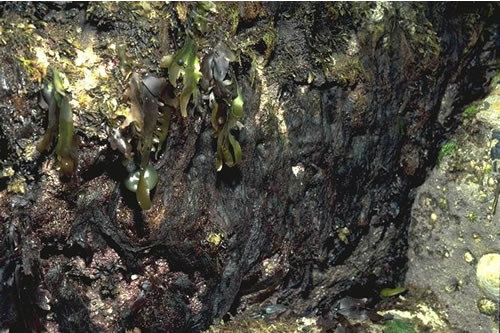
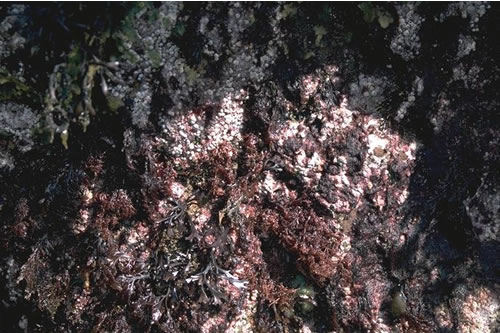
Sponges and shade-tolerant red seaweeds on overhanging lower eulittoral bedrock and in cave entrances
Physical habitat description
| Salinity | Full (30-35 ppt) |
|---|---|
| Wave exposure | Exposed, Moderately exposed, Sheltered |
| Tidal streams | |
| Substratum | Bedrock |
| Zone | Eulittoral - lower, Eulittoral - mid, Sublittoral fringe |
| Depth Band | |
| Other Features | Overhanging rock and cave entrances |
Download comparative physical and biological data. The comparative tables enable a rapid comparison of the species composition and principal physical characteristics between a given set of biotopes.

- Records used to define the biotope (core records)
- Other records assigned to this biotope, marked as 'certain'
- Other records assigned to this biotope, marked as 'uncertain'
Point data based on records in the UK Marine Recorder Snapshot.
Description
Overhanging shaded bedrock on the open lower shore and at the entrance to inner reaches of caves (where light availability permits), which is not subject to appreciable wave-surge, characterised by a shade-tolerant red seaweed community. It includes foliose species such as Plumaria plumosa, Palmaria palmata, Mastocarpus stellatus, Membranoptera alata and Osmundea pinnatifida, but Lomentaria articulata and coralline crusts are usually present as well. The foliose green seaweed Ulva lactuca can be present. The rock surface often supports dense populations of calcareous tube-forming polychaetes Spirorbis spp. and Spirobranchus spp., while sponges such as Grantia compressa, Halichondria panicea and Hymeniacidon perlevis can be common. The hydroid Dynamena pumila (normally found on fucoids) hangs in distinct form from overhanging rock. Colonies of the ascidian Botryllus schlosseri can be found on the rock, along with the mussel Mytilus edulis and the barnacles Semibalanus balanoides and Perforatus perforatus (the latter may occur at high densities in the south and west), while the anemone Actinia equina thrives in the permanently damp pits and crevices. The whelk Nucella lapillus can be found among the barnacles and mussels, preying on them. The long list of characterising species is partly due to the difference in the species composition and does not solely reflect a high species richness.
Situation
On overhangs, this biotope is generally found above the SByAs biotope, where there is more light available. In cave environments, SR may be found at the entrance to and inner reaches of the cave, extending from the lower walls (above the SByAs biotope) to the upper walls (depending on the height of the cave). Further into the cave where less light is available the ascidian Dendrodoa grossularia can be abundant (SR.Den).
Temporal variation
Unknown.
Characterising species
| Taxon | Relative importance of taxon for defining this community (%) | Typical abundance - SACFOR scale | % of core records where taxon was recorded |
|---|---|---|---|
| Halichondria panicea | 15 | Frequent | 81-100% |
| Lomentaria articulata | 9 | Common | 61-80% |
| Corallinaceae | 8 | Common | 41-60% |
| Plumaria plumosa | 8 | Frequent | 61-80% |
| Semibalanus balanoides | 5 | Frequent | 41-60% |
| Dynamena pumila | 5 | Frequent | 41-60% |
| Hymeniacidon perlevis | 5 | Occasional | 41-60% |
| Palmaria palmata | 4 | Occasional | 41-60% |
| Grantia compressa | 3 | Occasional | 21-40% |
| Osmundea pinnatifida | 3 | Frequent | 41-60% |
| Spirorbinae | 3 | Frequent | 41-60% |
| Actinia equina | 2 | Occasional | 21-40% |
| Perforatus perforatus | 2 | Frequent | 21-40% |
| Mastocarpus stellatus | 2 | Frequent | 21-40% |
| Membranoptera alata | 2 | Occasional | 21-40% |
| Mytilus edulis | 2 | Occasional | 21-40% |
| Spirobranchus | 2 | Occasional | 21-40% |
| Ulva lactuca | 2 | Occasional | 41-60% |
| Nucella lapillus | 2 | Occasional | 21-40% |
| Oshurkovia littoralis | 1 | Occasional | 21-40% |
Similar biotopes or habitat types
LR.FLR.CvOv.SpByAs
SR is distinguished from SByAs by its abundance of red algae; SByAs lacks the red algae, except for perhaps a few on the edge of the overhang.Classification history of this biotope or habitat type
| Classification version | Code |
|---|---|
| 1997 (97.06) | LR.SR |
| 1996 (6.95) | MLR.S.R |
| 1995 | LRK.RSP |
Photos