Description of biotope or habitat type
To understand more about what this page is describing, see How to use the classification. See also How to cite.
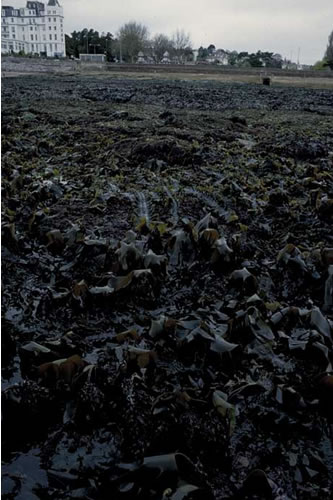
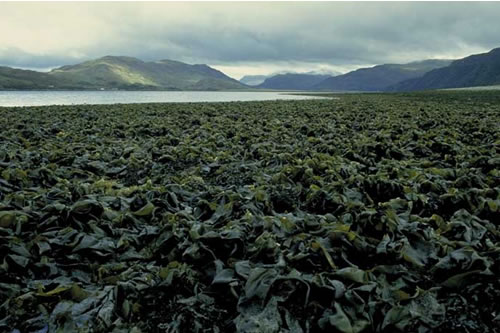
Saccharina latissima and Laminaria digitata on sheltered sublittoral fringe rock
Physical habitat description
| Salinity | Full (30-35 ppt), Variable (18-35 ppt) |
|---|---|
| Wave exposure | Sheltered, Very sheltered, Extremely sheltered |
| Tidal streams | Weak (>1 kn), Very weak (negligible) |
| Substratum | Bedrock; boulders and cobbles |
| Zone | Sublittoral fringe |
| Depth Band | 0-5 m, Lower shore |
| Other Features |
Download comparative physical and biological data. The comparative tables enable a rapid comparison of the species composition and principal physical characteristics between a given set of biotopes.

- Records used to define the biotope (core records)
- Other records assigned to this biotope, marked as 'certain'
- Other records assigned to this biotope, marked as 'uncertain'
- Predicted extent of the level 3 (for sublittoral rock & deep sea) or 4 (for sublittoral sediment) habitat
Point data based on records in the UK Marine Recorder Snapshot. Predicted habitat extent is from UKSeaMap.
Description
Sheltered bedrock and boulders in the sublittoral fringe characterised by a mixed canopy of the kelp Laminaria digitata (usually in its broad-fronded cape-form) and Saccharina latissima - both species are generally Frequent or greater. Beneath the kelp canopy, the understorey of red seaweeds often includes Chondrus crispus, Dumontia contorta, Bonnemaisonia hamifera and Plocamium cartilagineum. The surface of the rock is usually covered with encrusting coralline algae as well as non-calcified red crusts and the tube-building polychaete Spirobranchus triqueter. The brown seaweeds Chorda filum, Ectocarpaceae and Fucus serratus can be present along with the green seaweeds Ulva lactuca and Ulva intestinalis. Patches of the sponge Halichondria panicea can frequently be found in cracks and crevices. Beneath and between boulders a variety of mobile crustaceans such as Carcinus maenas, the gastropod Steromphala cineraria and the starfish Asterias rubens are common.
Situation
Where hard substrata occur on the shore, this biotope will be found below the F. serratus zone (Fser.Fser, Fser or FserX on mixed substrata). With such sheltered shores, the transition between sublittoral fringe and the true sublittoral zone may not be distinct; this biotope therefore extends into the shallow sublittoral kelp forest below (LhypLsac.Ft, Lsac.Ft or LhypCape).
Temporal variation
Unknown.
Characterising species
| Taxon | Relative importance of taxon for defining this community (%) | Typical abundance - SACFOR scale | % of core records where taxon was recorded |
|---|---|---|---|
| Laminaria digitata | 19 | Common | 81-100% |
| Saccharina latissima | 19 | Frequent | 81-100% |
| Corallinaceae | 6 | Frequent | 41-60% |
| Steromphala cineraria | 5 | Occasional | 61-80% |
| Chondrus crispus | 4 | Frequent | 41-60% |
| Ulva lactuca | 4 | Frequent | 41-60% |
| Spirobranchus triqueter | 3 | Frequent | 41-60% |
| Asterias rubens | 2 | Occasional | 41-60% |
| Chorda filum | 2 | Occasional | 41-60% |
| Ectocarpaceae | 2 | Frequent | 41-60% |
| Ulva intestinalis | 2 | Frequent | 21-40% |
| Fucus serratus | 2 | Occasional | 41-60% |
| Halichondria panicea | 2 | Occasional | 21-40% |
| Rhodophyta indet.(non-calc.crusts) | 2 | Frequent | 21-40% |
| Bonnemaisonia hamifera | 1 | Frequent | 21-40% |
| Carcinus maenas | 1 | Rare | 41-60% |
| Dumontia contorta | 1 | Occasional | 21-40% |
| Plocamium cartilagineum | 1 | Occasional | 21-40% |
Similar biotopes or habitat types
Not applicable or unknown.
Classification history of this biotope or habitat type
| Classification version | Code |
|---|---|
| 2015 (15.03) | IR.LIR.K.Lsac.Ldig |
| 1995 | LRK.LDIG.LSAC |