Description of biotope or habitat type
To understand more about what this page is describing, see How to use the classification. See also How to cite.
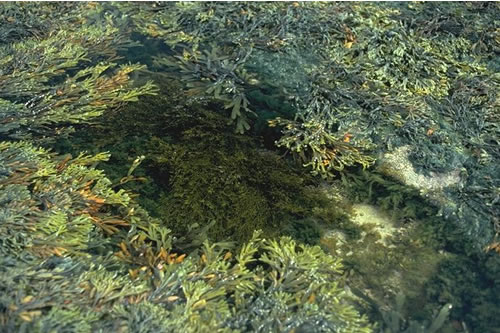
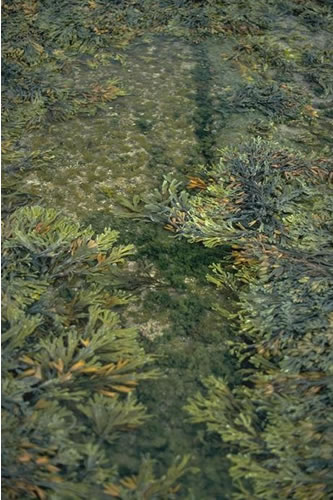
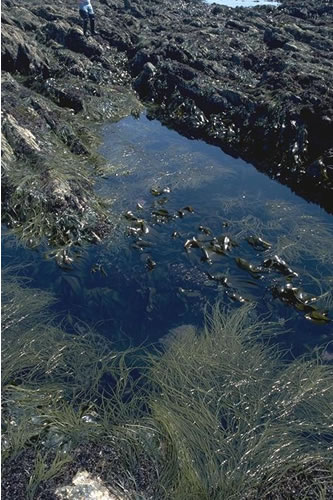
Fucoids and kelp in deep eulittoral rockpools
Physical habitat description
| Salinity | Full (30-35 ppt) |
|---|---|
| Wave exposure | Exposed, Moderately exposed |
| Tidal streams | |
| Substratum | Bedrock |
| Zone | Eulittoral - lower, Eulittoral - mid |
| Depth Band | Lower shore, Mid shore |
| Other Features | Deep rockpool with fucoids and kelp |
Download comparative physical and biological data. The comparative tables enable a rapid comparison of the species composition and principal physical characteristics between a given set of biotopes.

- Records used to define the biotope (core records)
- Other records assigned to this biotope, marked as 'certain'
- Other records assigned to this biotope, marked as 'uncertain'
Point data based on records in the UK Marine Recorder Snapshot.
Description
Deep or larger rockpools in the mid to lower eulittoral zone on exposed to moderately exposed shores characterised by the wrack Fucus serratus and the kelp Laminaria digitata and the red seaweed Corallina officinalis while encrusting coralline algae cover the rock surface. Other large brown seaweeds, including the kelp Saccharina latissima and Halidrys siliquosa may also occur. A wide variety of filamentous and foliose seaweeds occur beneath the brown algal canopy. The species includes the red seaweeds Palmaria palmata, Chondrus crispus, Mastocarpus stellatus, Ceramium nodulosum and Dumontia contorta, but green seaweeds such as Ulva intestinalis, Ulva lactuca and Cladophora rupestris can be present as well. Algal-free vertical and overhanging faces often support the sponge Halichondria panicea and anemones including Actinia equina and Urticina felina. Grazing molluscs including the limpet Patella vulgata, the top shell Steromphala cineraria and the winkle Littorina littorea are present on the rock surface while the mussel Mytilus edulis can be found in cracks and crevices. The whelk Nucella lapillus can be found preying on the mussels. Where boulders occur in these pools they provide a greater variety of micro-habitats which support a variety of fauna. Mobile crustaceans including the crabs Pagurus bernhardus and Carcinus maenas, brittlestars such as Ophiothrix fragilis and Amphipholis squamata, encrusting bryozoans and ascidians are typically found beneath and between boulders.
Situation
Rockpools throughout the eulittoral zone in bedrock on exposed and moderately exposed shores.
Temporal variation
The abundance of grazing molluscs can vary considerably both spatially and temporally, resulting in fluctuations in algal diversity and abundance.
Characterising species
| Taxon | Relative importance of taxon for defining this community (%) | Typical abundance - SACFOR scale | % of core records where taxon was recorded |
|---|---|---|---|
| Corallina officinalis | 15 | Common | 81-100% |
| Corallinaceae | 13 | Abundant | 61-80% |
| Laminaria digitata | 8 | Occasional | 61-80% |
| Fucus serratus | 5 | Frequent | 41-60% |
| Chondrus crispus | 4 | Occasional | 41-60% |
| Ulva lactuca | 4 | Occasional | 41-60% |
| Ceramium nodulosum | 3 | Frequent | 41-60% |
| Littorina littorea | 3 | Frequent | 41-60% |
| Mastocarpus stellatus | 3 | Occasional | 41-60% |
| Patella vulgata | 3 | Occasional | 41-60% |
| Actinia equina | 2 | Occasional | 21-40% |
| Dumontia contorta | 2 | Occasional | 41-60% |
| Halidrys siliquosa | 2 | Frequent | 21-40% |
| Palmaria palmata | 2 | Occasional | 41-60% |
| Cladophora | 1 | Occasional | 21-40% |
| Cladophora rupestris | 1 | Occasional | 21-40% |
| Steromphala cineraria | 1 | Occasional | 21-40% |
| Halichondria panicea | 1 | Occasional | 21-40% |
| Saccharina latissima | 1 | Occasional | 21-40% |
| Mytilus edulis | 1 | Occasional | 21-40% |
| Nucella lapillus | 1 | Occasional | 21-40% |
Similar biotopes or habitat types
LR.FLR.Rkp.Cor
The variants of the LR.FLR.Rkp.Cor biotope do not have the same presence of large brown seaweeds and they occur across a broader range of wave exposure.
LR.FLR.Rkp.FK.Sar
Similar type of rockpool with similar species richness and species composition though the brown seaweed Sargassum muticum dominates instead of F. serratus. Ulva lactuca occursat a high abundance (Common).Classification history of this biotope or habitat type
| Classification version | Code |
|---|---|
| 1996 (6.95) | RKP.FK.Bed |
| 1996 (6.95) | RKP.FK.Bo (part) |
| 1995 | LRK.FK.BEP |
Photos