Description of biotope or habitat type
To understand more about what this page is describing, see How to use the classification. See also How to cite.
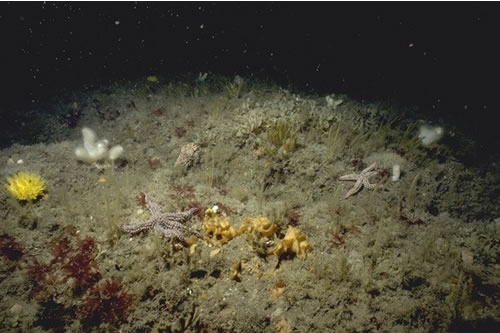
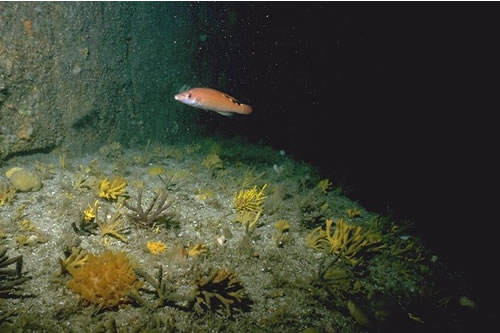
Mixed turf of bryozoans and erect sponges with Dysidea fragilis and Actinothoe sphyrodeta on tide-swept wave-exposed circalittoral rock
Physical habitat description
| Salinity | Full (30-35 ppt) |
|---|---|
| Wave exposure | Extremely exposed, Very exposed, Exposed, Moderately exposed |
| Tidal streams | Strong (3-6 kn), Moderately strong (1-3 kn) |
| Substratum | Bedrock; boulder |
| Zone | Circalittoral - lower, Circalittoral - upper |
| Depth Band | 5-10 m, 10-20 m, 20-30 m |
| Other Features |
Download comparative physical and biological data. The comparative tables enable a rapid comparison of the species composition and principal physical characteristics between a given set of biotopes.

- Records used to define the biotope (core records)
- Other records assigned to this biotope, marked as 'certain'
- Other records assigned to this biotope, marked as 'uncertain'
- Predicted extent of the level 3 (for sublittoral rock & deep sea) or 4 (for sublittoral sediment) habitat
Point data based on records in the UK Marine Recorder Snapshot. Predicted habitat extent is from UKSeaMap.
Description
This variant typically occurs on exposed and moderately wave-exposed bedrock and boulders subject to a variety of tidal regimes (from strong through to weak). It is found mainly in the 10-20m depth range and does not usually occur deeper than 30 m. It therefore often straddles the upper circalittoral and lower infralittoral. It often has a light covering of silt and sand may be in the vicinity. Sponges form a dominant part of this variant, although cover usually appears patchy, with no single species dominating. Species present include Dysidea fragilis, Pachymatisma johnstonia, Amphilectus fucorum, Hemimycale columella, Cliona celata, Stelligera montagui, Polymastia boletiformis, Stelligera stuposa, Raspailia ramosa, Tethya aurantium, Polymastia mamillaris and Axinella dissimilis. Tufts of large hydroids such as Nemertesia antennina, frequently recorded on the tops of outcrops and boulders, stand out more clearly than the understorey of finer hydroid and bryozoan turf such as Aglaophenia pluma, Bugulina flabellata, Crisularia plumosa, crisiids, Cellaria sinuosa and Bugulina turbinata. Other bryozoans such as Alcyonidium diaphanum and Flustra foliacea are also frequently recorded. Other more widespread species present include Asterias rubens, Actinothoe sphyrodeta, Balanus crenatus, Caryophyllia smithii, Corynactis viridis, Necora puber and Clavelina lepadiformis. This variant has been recorded off the south east coast of Ireland, the welsh coast and Lundy Island.
Situation
This biotope is typically found on exposed coasts, with exposed kelp forest in the infralittoral zone, characterised by species such as Laminaria hyperborea and Saccorhiza polyschides. The ByErSp.DysAct variant is usually found below ByErSp.Eun, with similar geographic range.
Temporal variation
Not known.
Characterising species
| Taxon | Relative importance of taxon for defining this community (%) | Typical abundance - SACFOR scale | % of core records where taxon was recorded |
|---|---|---|---|
| Dysidea fragilis | 5 | Frequent | 81-100% |
| Asterias rubens | 4 | Frequent | 81-100% |
| Pachymatisma johnstonia | 4 | Occasional | 81-100% |
| Actinothoe sphyrodeta | 3 | Frequent | 81-100% |
| Alcyonium digitatum | 3 | Occasional | 61-80% |
| Balanus crenatus | 3 | Frequent | 61-80% |
| Caryophyllia smithii | 3 | Frequent | 61-80% |
| Amphilectus fucorum | 3 | Frequent | 81-100% |
| Flustra foliacea | 3 | Frequent | 61-80% |
| Nemertesia antennina | 3 | Frequent | 61-80% |
| Alcyonidium diaphanum | 2 | Frequent | 61-80% |
| Bugulina flabellata | 2 | Occasional | 61-80% |
| Crisularia plumosa | 2 | Frequent | 61-80% |
| Cliona celata | 2 | Occasional | 61-80% |
| Crisiidae | 2 | Common | 41-60% |
| Hemimycale columella | 2 | Occasional | 61-80% |
| Polymastia boletiformis | 2 | Frequent | 41-60% |
| Raspailia ramosa | 2 | Occasional | 61-80% |
| Stelligera montagui | 2 | Occasional | 61-80% |
| Stelligera stuposa | 2 | Occasional | 61-80% |
| Aglaophenia pluma | 1 | Frequent | 41-60% |
| Axinella dissimilis | 1 | Occasional | 41-60% |
| Bryozoa | 1 | Frequent | 41-60% |
| Bugulina turbinata | 1 | Frequent | 41-60% |
| Cellaria sinuosa | 1 | Frequent | 41-60% |
| Clavelina lepadiformis | 1 | Occasional | 41-60% |
| Corynactis viridis | 1 | Frequent | 41-60% |
| Necora puber | 1 | Occasional | 61-80% |
| Polymastia mamillaris | 1 | Occasional | 61-80% |
| Tethya aurantium | 1 | Occasional | 61-80% |
Similar biotopes or habitat types
CR.HCR.XFa.ByErSp.Eun
This sub-biotope is found on very wave-exposed circalittoral bedrock with slightly weaker tidal streams than CR.HCR.XFa.ByErSp.DysAct. It is also found slightly deeper than CR.HCR.XFa.ByErSp.DysAct. E. verrucosa is absent from CR.HCR.XFa.ByErSp.DysAct.
CR.HCR.XFa.ByErSp.Cyl
This sub-biotope occurs under similar wave-exposure conditions but with weaker tides than CR.HCR.XFa.ByErSp.DysAct. It is also found slightly deeper than CR.HCR.XFa.ByErSp.DysAct. Both sub-biotopes have similar suites of species but distinct geographical distributions: CR.HCR.XFa.ByErSp.DysAct only tends to be found off Wales and Lundy whereas CR.HCR.XFa.ByErSp.Cyl is usually found off the west coast of Ireland.
CR.HCR.XFa.FluCoAs
This biotope occurs under similar wave-exposure conditions, but with slightly weaker tides than CR.HCR.XFa.ByErSp.DysAct. Both tend to occur throughout similar depth ranges and substratum. They also both tend to have a thin layer of silt overlying them. Sponges, hydroids and bryozoans are present in both biotopes; although F. foliacea is present in CR.HCR.XFa.ByErSp.DysAct, it is not present to the same abundance as in CR.HCR.XFa.FluCoAs, where it forms dense aggregations on the bedrock and boulders. In addition, species such as C. smithii and C. viridis are absent from CR.HCR.XFa.FluCoAs.Classification history of this biotope or habitat type
| Classification version | Code |
|---|---|
| 1997 (97.06) | CR.MCR.XFa.ErSPbolSH |
Photos