Description of biotope or habitat type
To understand more about what this page is describing, see How to use the classification. See also How to cite.
Laminaria digitata and under-boulder fauna on sublittoral fringe boulders
Physical habitat description
| Salinity | Full (30-35 ppt) |
|---|---|
| Wave exposure | Moderately exposed, Sheltered |
| Tidal streams | Moderately strong (1-3 kn), Weak (>1 kn), Very weak (negligible) |
| Substratum | Boulders |
| Zone | Sublittoral fringe |
| Depth Band | 0-5 m, Lower shore |
| Other Features | Under-boulder habitats |
Download comparative physical and biological data. The comparative tables enable a rapid comparison of the species composition and principal physical characteristics between a given set of biotopes.

- Records used to define the biotope (core records)
- Other records assigned to this biotope, marked as 'certain'
- Other records assigned to this biotope, marked as 'uncertain'
- Predicted extent of the level 3 (for sublittoral rock & deep sea) or 4 (for sublittoral sediment) habitat
Point data based on records in the UK Marine Recorder Snapshot. Predicted habitat extent is from UKSeaMap.
Description
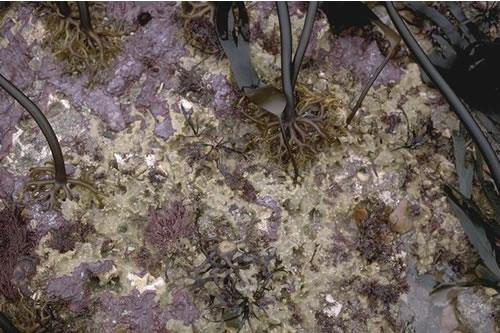
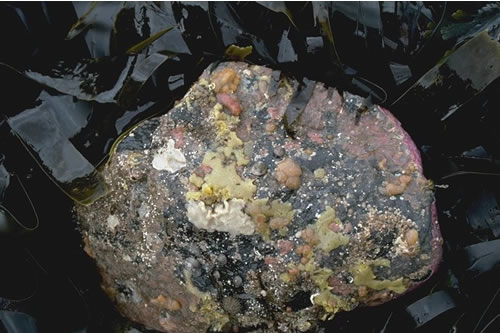
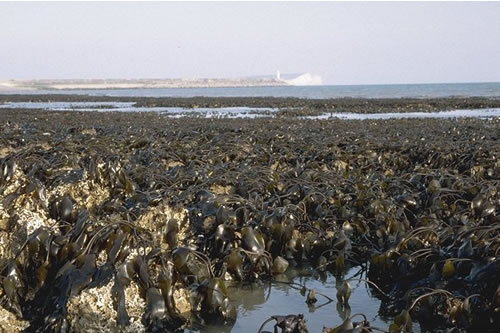
This Laminaria digitata biotope is found predominantly on moderately exposed boulder shores and occasionally also on exposed or sheltered shores. Upper surfaces of the boulders are colonised by dense L. digitata though other kelp such as Laminaria hyperborea and Saccharina latissima or the wrack Fucus serratus can be present at lower abundance. The kelp fronds can be colonised by the bryozoan Membranipora membranacea. Beneath the kelp canopy are a variety of red seaweeds such as Mastocarpus stellatus, Chondrus crispus, Palmaria palmata, Membranoptera alata, Corallina officinalis and coralline crusts. Green seaweeds include Cladophora rupestris and Ulva lactuca. Where space is available beneath the boulders (i.e. they are not buried in sediment) there may be a rich assemblage of animals. Characteristic species include the crabs Porcellana platycheles, Pisidia longicornis and juvenile Cancer pagurus. Also present beneath the boulders are often high densities of the barnacle Balanus crenatus, the tube-building polychaete Spirobranchus triqueter, spirorbid worms, the polychaete Harmotho� sp., gammarid amphipods and a few gastropods such as Steromphala cineraria. The encrusting bryozoans Electra pilosa and Oshurkovia littoralis and encrusting colonies of the sponges Halichondria panicea and Halisarca dujardinii are also typical of this habitat. The richest examples also contain a variety of echinoderms such as Asterias rubens, colonial ascidians such as Botryllus schlosseri and small hydroids.
Situation
This biotope is found in a similar situation to Ldig.Ldig, usually beneath the Fucus serratus zone (Fser.Bo or Fser.R) and above the Laminaria hyperborea zone (Lhyp). Many of the animals found under boulders in the lower shore in Fser.Bo are also found under boulders in the sublittoral fringe (Ldig.Bo), particularly the sponges and crabs. Similarly, many of the seaweeds present on the lower shore are also present in the shallow sublittoral fringe.
Temporal variation
Unknown
Characterising species
| Taxon | Relative importance of taxon for defining this community (%) | Typical abundance - SACFOR scale | % of core records where taxon was recorded |
|---|---|---|---|
| Laminaria digitata | 15 | Abundant | 81-100% |
| Corallinaceae | 10 | Common | 81-100% |
| Chondrus crispus | 6 | Frequent | 81-100% |
| Halichondria panicea | 5 | Occasional | 81-100% |
| Electra pilosa | 4 | Occasional | 61-80% |
| Palmaria palmata | 4 | Frequent | 61-80% |
| Spirobranchus triqueter | 4 | Occasional | 61-80% |
| Steromphala cineraria | 3 | Occasional | 61-80% |
| Balanus crenatus | 2 | Frequent | 41-60% |
| Botryllus schlosseri | 2 | Occasional | 41-60% |
| Cladophora rupestris | 2 | Frequent | 41-60% |
| Corallina officinalis | 2 | Occasional | 61-80% |
| Fucus serratus | 2 | Occasional | 61-80% |
| Mastocarpus stellatus | 2 | Frequent | 41-60% |
| Spirorbinae | 2 | Frequent | 41-60% |
| Membranipora membranacea | 1 | Occasional | 41-60% |
| Asterias rubens | 1 | Occasional | 41-60% |
| Cancer pagurus | 1 | Rare | 41-60% |
| Halisarca dujardinii | 1 | Occasional | 41-60% |
| Harmothoe | 1 | Occasional | 41-60% |
| Laminaria hyperborea | 1 | Occasional | 41-60% |
| Saccharina latissima | 1 | Occasional | 41-60% |
| Membranoptera alata | 1 | Occasional | 41-60% |
| Pisidia longicornis | 1 | Occasional | 21-40% |
| Porcellana platycheles | 1 | Occasional | 21-40% |
| Ulva lactuca | 1 | Occasional | 41-60% |
| Oshurkovia littoralis | 1 | Frequent | 21-40% |
Similar biotopes or habitat types
Not applicable or unknown.
Classification history of this biotope or habitat type
| Classification version | Code |
|---|---|
| 1997 (97.06) | MIR.Ldig.Ldig.Bo |
| 1996 (6.95) | MIR.Ldig.Bo |
| 1995 | LRK.BSP (part) |
Photos