Description of biotope or habitat type
To understand more about what this page is describing, see How to use the classification. See also How to cite.
Seaweeds in sediment-floored eulittoral rockpools
Physical habitat description
| Salinity | Full (30-35 ppt) |
|---|---|
| Wave exposure | Exposed, Moderately exposed, Sheltered |
| Tidal streams | |
| Substratum | Bedrock with cobbles, pebbles and/ or sand |
| Zone | Eulittoral |
| Depth Band | Lower shore, Mid shore |
| Other Features | Sand abrasion/ covered rock in rockpool; or unstable sediment (gravel/pebbles) |
Download comparative physical and biological data. The comparative tables enable a rapid comparison of the species composition and principal physical characteristics between a given set of biotopes.

- Records used to define the biotope (core records)
- Other records assigned to this biotope, marked as 'certain'
- Other records assigned to this biotope, marked as 'uncertain'
Point data based on records in the UK Marine Recorder Snapshot.
Description
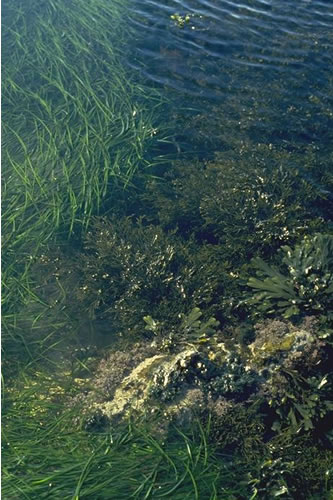
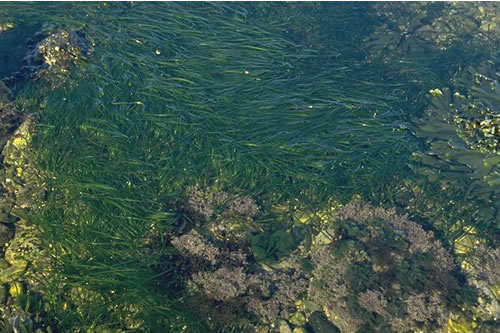
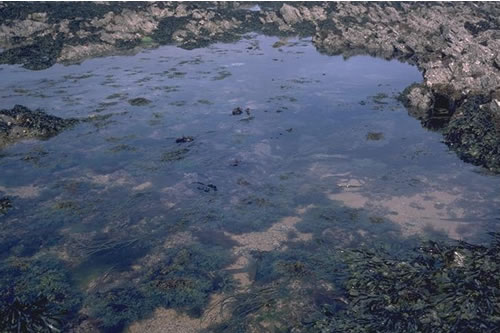
Rockpools with sediment (mud, sand, gravel) floors support distinct communities of scour-tolerant seaweeds. Deep pools with sediment are similar to FK, and are typically dominated by fucoids and kelp (Fucus serratus, Laminaria digitata, Saccharina latissima and Saccorhiza polyschides). Areas of hard substrata near to the interface with the sediment are, however, characterised by a range of sand-tolerant seaweeds such as Furcellaria lumbricalis, Polyides rotunda, Ahnfeltia plicata and Rhodochorton purpureum (compare with FK). Chorda filum may occur attached to pebbles and shells embedded within the sediment while the top shell Steromphala cineraria can be found underneath or among the pebbles. In pools with large areas of sand, infaunal species such as Arenicola marina and Lanice conchilega often occur. The seagrass Zostera spp. may occur in some pools where stable sand is present. Shallow rockpools with cobble and pebble floors, often with an underlying layer of sediment, support red algal tufts consisting of coralline crust, Corallina officinalis, Chondrus crispus, Mastocarpus stellatus mixed with Ceramium spp. and the green seaweeds Cladophora spp. and Ulva intestinalis. The long list of characterising species is partly due to low similarity between the available records and care should be taken not to interpret this solely as a very high species richness.
Situation
Rockpools throughout the eulittoral zone in bedrock on exposed to sheltered shores.
Temporal variation
Seasonal fluctuations in the abundance of ephemeral seaweeds will occur.
Characterising species
| Taxon | Relative importance of taxon for defining this community (%) | Typical abundance - SACFOR scale | % of core records where taxon was recorded |
|---|---|---|---|
| Corallina officinalis | 13 | Frequent | 61-80% |
| Corallinaceae | 11 | Frequent | 61-80% |
| Chondrus crispus | 6 | Occasional | 61-80% |
| Fucus serratus | 5 | Occasional | 41-60% |
| Littorina littorea | 5 | Frequent | 41-60% |
| Ulva lactuca | 5 | Occasional | 41-60% |
| Ceramium | 3 | Frequent | 41-60% |
| Ceramium nodulosum | 3 | Frequent | 21-40% |
| Ulva intestinalis | 3 | Frequent | 21-40% |
| Laminaria digitata | 3 | Frequent | 41-60% |
| Cladophora | 2 | Occasional | 41-60% |
| Steromphala cineraria | 2 | Occasional | 41-60% |
| Mastocarpus stellatus | 2 | Frequent | 21-40% |
| Patella vulgata | 2 | Occasional | 21-40% |
| Arenicola marina | 1 | Rare | 21-40% |
| Furcellaria lumbricalis | 1 | Occasional | 21-40% |
| Polyides rotunda | 1 | Occasional | 21-40% |
Similar biotopes or habitat types
Not applicable or unknown.
Classification history of this biotope or habitat type
| Classification version | Code |
|---|---|
| 1996 (6.95) | Includes RKP.RBwn |
| 1996 (6.95) | RKP.FK.Snd |
| 1995 | LRK.FK.SP |
Photos